Snow sculptures at Sapporo Snow Festival 2009

Here are some photos of giant snow sculptures from the 60th annual Sapporo Snow Festival, which runs until February 11.

Yuki Matsuri 2009 --
Hakodate Magistrate’s Office [Photo: Moontears]

?60????????? --
Kinnikuman [Photo: Talk P]

??? --
Namdaemun (check out the the LIVE WEBCAM [WMP]) [Photo: Sasakei]

Yuki Festival 2009 --
Namdaemun under construction [Photo: tetsu]

Snow Festival, Sapporo, Hokkaido --
Olympic gold medalist swimmer K?suke Kitajima [Photo: Sasakei]

Snow sculpture --
Kitajima under construction [Photo: tetsu]

60th Anniversary Snow Festival 2009 --
Hamamatsu Castle [Photo: Talk P]

Yuki Matsuri 2009 --
Sento-kun & Manto-kun [Photo: tetsu]

Sapporo Snow Festival 2009 --
25 years in Japan [Photo: Sasakei]

Ice sculpture --
Japan Self-Defense Force soldiers cleaning mouse heads [Photo: Reuters]

Ice sculpture --
Stitch [Photo: Talk P]

????? --
Tsuyo Ink [Photo: Sapporo Snow Festival Official Site]

?????? --
Snow Zoo [Photo: bigarnex]

?????? --
Alien Baltan [Photo: bigarnex]

?????? --
Pekkle [Photo: bigarnex]

Video: Starfish Hitler

Via The Echinoblog’s profile of starfish-themed monsters in Japanese cinema come these classic clips of Starfish Hitler, a Government of Darkness (G.O.D.) villain who battled superhero Kamen Rider X on TV in 1974.


+ Part 1: Kamen Rider X vs Starfish Hitler


+ Part 2: Kamen Rider X vs Starfish Hitler

[Link: The Echinoblog]

Photos: Yoichiro Kawaguchi’s robot designs

More photos of Yoichiro Kawaguchi’s robot designs on display at Yushima Seid? temple in Tokyo:

Yoichiro Kawaguchi robot design --

Yoichiro Kawaguchi robot design --

Yoichiro Kawaguchi robot design -- Yoichiro Kawaguchi robot design --

Yoichiro Kawaguchi robot design --

Yoichiro Kawaguchi robot design --

Yoichiro Kawaguchi robot design -- Yoichiro Kawaguchi robot design --

Yoichiro Kawaguchi robot design --

Yoichiro Kawaguchi robot design --

Yoichiro Kawaguchi robot design -- Yoichiro Kawaguchi robot design --

Yoichiro Kawaguchi robot design --

Yoichiro Kawaguchi robot design --

Yoichiro Kawaguchi robot design -- Yoichiro Kawaguchi robot design --

Yoichiro Kawaguchi robot design --

‘Organic’ robots to mimic primitive life

Primitive lifeforms as robots --

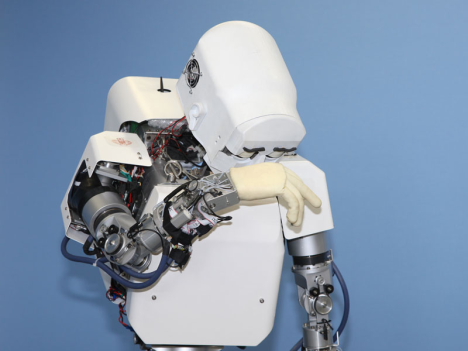
A University of Tokyo research team led by professor/computer graphic artist Yoichiro Kawaguchi is developing robots designed to imitate primitive life forms. Mockups have been put on display at a Confucian temple in Tokyo, and working versions of the robots are scheduled for completion in two years.

According to the researchers, these robots are being developed as a way to explore artificial life and gain insights into how living things survive in a world governed by the law of the jungle.

Primitive lifeforms as robots --

Kawaguchi and his team are developing a basic reflex system for the primitive artificial life forms, as well as a visual processing system equipped with eyes that recognize and instinctively track certain objects.

In addition, the researchers are working to create powerful biomimetic actuators for locomotion. As part of their research, Kawaguchi and his team have conducted computer simulations to investigate the use of neural oscillators in a locomotion system that imitates the way centipedes crawl. They are also working on simple, mechanical tentacles that extend and contract to move the robot in a specified direction. If all goes according to schedule, they will have a fully functional robot in two years.

Primitive lifeforms as robots --

With a more thorough understanding of how primitive life forms survive, the researchers believe they can provide robots with a better ability to move, hunt, sense danger, and escape. They suggest that strong survival and hunting skills can be put to use in applications ranging from security guard dog robots to swarm robots tasked with exploring the surface of an alien planet.

Primitive lifeforms as robots --

Kawaguchi, a professor at the University of Tokyo Graduate School of Interdisciplinary Information Studies, has become known for creating artistic computer graphics programs that exhibit “lifelike” behavior such as self-organization and self-propagation. The robot mockups, which are three-dimensional models of his previous computer graphics work, will remain on display at Yushima Seid? temple until February 8.

[Source: Robot Watch]

UPDATE: More photos HERE.

Bunraku puppet robots resurrected (pics/video)

Bunraku robot -- Bunraku robot --

A trio of old-school bunraku puppet robots revived nearly 40 years after they were unveiled at the 1970 World Expo in Osaka are temporarily on display at the National Science Museum in Tokyo. Modeled after classic bunraku puppets, each pre-programmed robot is driven by around 20 pneumatic cylinders that move the arms, torso, head and face in sync with accompanying audio.

Here’s some dramatic video of one whose face transforms into that of a demon:


+ Bunraku robot

A few more photos of the other robots, which are on display at the Science Museum until February 8:

Bunraku robot -- Bunraku robot -- Bunraku robot --

Bunraku robot --

Bunraku robot --

Bunraku robot --

Bunraku robot --

Bunraku robot --

Security firm proudly uses imitation Yahoo logo

Yaroo Security logo --

The company logo for Yaroo Security, a security guard firm based in Tokyo’s Katsushika ward, looks suspiciously like the one for Japan’s most popular search engine. In this video, a camera crew visits Yaroo headquarters to ask about the resemblance.

A company spokesman flatly denies that their logo is an imitation of Yahoo’s, although he admits, with a smile, that the logo designers did refer to it a little bit. Later in the interview (edited out), the spokesman explains that the name “Yaroo” is a play on the word “yaru” (meaning “do”) — a reference to their do-anything style of business.

1,000 Paro robots migrating to Denmark

PARO Mental Commit Robot --

The largest-ever migration of baby harp seal robots from Japan is about to begin, following an agreement by Denmark to purchase 1,000 of them for use in health care facilities. Paro, a human-interactive robotic seal developed by Japan’s National Institute of Advanced Industrial Science and Technology (AIST), has scientifically demonstrated the ability to elicit emotions, activate the mind and calm nerves in patients at hospitals and nursing homes, earning it the Guinness title of “world’s most therapeutic robot.” Although the well-traveled Paro now resides at welfare institutions in more than 20 nations around the world, the Danish government is the first organization to make a large-scale purchase. Denmark aims to have the Paro robots in their new homes by 2011.

[Sources: Jiji, Chunichi]

New Japanese souvenir designs

Eleven winners of the “Japanese New Souvenir” competition — a public contest to recognize novel souvenir concepts that creatively express elements of Japanese culture — were exhibited last weekend as part of the Design Touch festivities at the Tokyo Midtown complex. Coming soon to a souvenir shop near you.

Moustache Fuji --
Moustache Fuji (Mariko Takeuchi)

“Moustache Fuji,” a fake moustache resembling a snow-capped Mt. Fuji, is a subtle but bold fashion statement that pays homage to Japan’s most sacred landmark. Described as a “moustache communication tool,” this fun-to-wear facial accessory lets you inject a little Japanese flair into meetings, parties and summits.

Air-Bonsai --
Air-Bonsai (Wabisabi)

“Air-Bonsai,” a vinyl toy shaped like a potted dwarf pine, gives the traditional Japanese art of bonsai a pop-culture makeover. The soft vinyl tree packs flat into your suitcase for easy transport home.

Japanese, Face --
Japanese, Face (Kozue Kojima)

These “Japanese, Face” beauty masks moisturize the skin while giving you a traditional Japanese kabuki-esque appearance.

139 Views of Mt. Fuji --
139 Views of Mt. Fuji (Keita Suzuki)

Inspired by Hokusai’s famous “36 Views of Mount Fuji” series of woodblock prints, the “139 Views of Mt. Fuji” drinking glass lets you reflect on the ephemeral beauty of Mt. Fuji and the Japanese seasons while you drink. Enjoy a different “view” of the mountain with each new type of beverage you pour.

Other top souvenir concepts (not pictured) include “Kutsu-kutsushita” socks colored to look like shoes, incense sticks tied into traditional mizuhiki knots, and a round red “Hinomaru” paperweight that instantly transforms a stack of paper into the Japanese flag.

In addition to cash prizes, the winning designers will receive active support to help turn their concepts into marketable products. The contest was organized by Tokyo Midtown Design Hub, a consortium of industrial designers, graphic designers and educators focused on promoting Japanese design.

Video: Chopstick octopus

Octopus made of chopsticks --

Recycle artist Masataka Koike creates realistic-looking marine life sculptures from used wooden chopsticks. This octopus, which took eight months to complete, is made of 2,000 chopsticks.


Chopstick octopus

Photos: Robots at CEATEC 2008

Robots old and new are on display at the CEATEC 2008 home electronics trade show currently underway in Chiba, Japan.

Nissan BR23C Biomimetic Robot Car at CEATEC 2008 --
Nissan BR23C Biomimetic Robot Car

Nissan unveiled the bumblebee-inspired BR23C Biomimetic Robot Car, which is equipped with a prototype collision avoidance system developed in cooperation with the University of Tokyo. The next-generation safety technology is modeled after the way that bees avoid crashing into each other.

* * * * *

Mechadroid Type C3 at CEATEC 2008 --
Mechadroid Type C3

The Mechadroid Type C3 receptionist robot developed by Business Design Laboratory relies on face recognition technology, a touch panel display, speech, and facial expressions to interact with visitors and guide them to their destination.

* * * * *

ifbot at CEATEC 2008 --
ifbot

Ifbot — also developed by Business Design Laboratory — is a speech-capable robot that can identify emotions in the voice and word choice of the person talking. The robot can also communicate its own emotions with a range of facial expressions.

* * * * *

Murata Seiko-chan and Seisaku-kun (Murata Boy) at CEATEC 2008 --
Murata Seiko-chan and Seisaku-kun (a.k.a. Murata Boy)

Murata Manufacturing Co., Ltd.’s popular robot bicyclist, Murata Seisaku-kun (a.k.a. Murata Boy), was joined on stage by his recently-unveiled younger cousin, Murata Seiko-chan, who is well-balanced enough to ride a unicycle.

* * * * *

Nabaztag at CEATEC 2008 --
Nabaztag

The Nabaztag Wi-Fi Smart Rabbit manufactured by Violet is a bunny-shaped personal assistant that connects to your home wireless network.

Nabaztag at CEATEC 2008 --
Nabaztag

In addition to announcing the latest news, weather and traffic information, the rabbit can tell the time, light up when email arrives, stream Internet radio and podcasts, and respond to spoken commands.

* * * * *

Enon at CEATEC 2008 --
Enon leads the way to the wine section

Fujitsu’s Enon robot demonstrated the ability to interact with customers and guide them to the wine section.

Enon at CEATEC 2008 --
Enon takes a break