
 On June 15, electronics giant Matsushita Electric (Panasonic's parent company) unveiled a wearable robot suit called Power Pedal, which attaches to the lower body and provides users with up to seven times more leg strength.
Once strapped in, the user applies pressure to a pair of sensor-equipped pedals to control the suit, which is capable of moving in one of six directions with each step. Power Pedal is also designed to handle strolls over rough terrain, according to Matsushita.
Researchers from Active Link, a Matsushita venture company, worked with Ritsumeikan University to develop a prototype of the powered suit, which is set to go on sale in August at a price of 20 million yen ($167,000) each. The company plans to cut the cost to around 3.5 million yen ($30,000) by the year 2015, as they aim to create a commercial product that can help the elderly and disabled to walk.
Matsushita also believes the robot suit could play a useful role in disaster relief operations, especially if combined with the company's previous upper body robot suit technology developed in 2005, which is designed to provide users with an extra 50 kilograms (110 lbs) of arm strength.
[Source: Yomiuri]
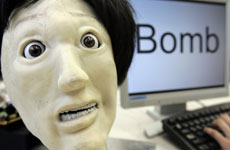 Kansei, a robot face capable of 36 expressions that vary according to emotional interpretations of words it hears, is the latest achievement to emerge from a Meiji University research lab working to develop conscious and

 The 130 cm long, 33 kg robot features 56 air cylinders that serve as muscles. With cameras for eyes and microphones for ears, and with 197 tactile sensors embedded in the layer of soft silicone skin covering its entire body, CB2 is well-equipped to take in environmental stimuli. When CB2's shoulders are tapped, it blinks as if surprised, stops moving, and turns its gaze toward the person who touched it, and when a toy is dangled in front of its eyes, it appears to devote all its energy to trying to reach for it. CB2 also has a set of artificial vocal chords that it uses to speak baby talk.

 On May 18,
  Researchers at Gifu University's Graduate School of Medicine have developed a robotic patient that can respond verbally to questions about how it feels and move its body in ways that exhibit the symptoms of its ailment. The researchers, who
  Robots can get away with things that humans cannot. In the Minami area of Osaka, for example, a humanoid robot dressed in a "sailor suit" high school uniform now works the street as a tout for an adult information center that navigates potential customers to local sex clubs. Humans in Osaka are prohibited by law from engaging in such nefarious activity.