
Yōkai Daizukai, an illustrated guide to yōkai authored by manga artist Shigeru Mizuki, features a collection of cutaway diagrams showing the anatomy of 85 traditional monsters from Japanese folklore (which also appear in Mizuki's GeGeGe no Kitarō anime/manga). Here are a few illustrations from the book.

Kuro-kamikiri [+]

The Kuro-kamikiri ("black hair cutter") is a large, black-haired creature that sneaks up on women in the street at night and surreptitiously cuts off their hair. Anatomical features include a brain wired for stealth and trickery, razor-sharp claws, a long, coiling tongue covered in tiny hair-grabbing spines, and a sac for storing sleeping powder used to knock out victims. The digestive system includes an organ that produces a hair-dissolving fluid, as well as an organ with finger-like projections that thump the sides of the intestines to aid digestion.
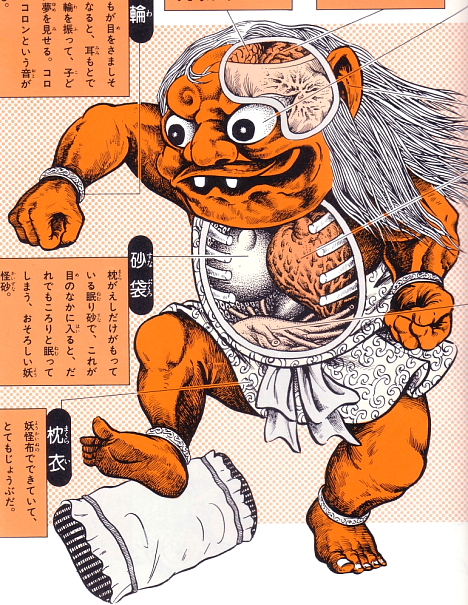
Makura-gaeshi [+]

The Makura-gaeshi ("pillow-mover") is a soul-stealing prankster known for moving pillows around while people sleep. The creature is invisible to adults and can only be seen by children. Anatomical features include an organ for storing souls stolen from children, another for converting the souls to energy and supplying it to the rest of the body, and a pouch containing magical sand that puts people to sleep when it gets in the eyes. In addition, the monster has two brains -- one for devising pranks, and one for creating rainbow-colored light that it emits through its eyes.

Doro-ta-bō [+]

The Doro-ta-bō ("muddy rice field man"), a monster found in muddy rice fields, is said to be the restless spirit of a hard-working farmer whose lazy son sold his land after he died. The monster is often heard yelling, "Give me back my rice field!" Anatomical features include a gelatinous lower body that merges into the earth, a 'mud sac' that draws nourishment from the soil, lungs that allow the creature to breathe when buried, and an organ that converts the Doro-ta-bō's resentment into energy that heats up his muddy spit. One eyeball remains hidden under the skin until the monster encounters the owner of the rice field, at which time the eye emerges and emits a strange, disorienting light.

Hyōsube [+]

The Hyōsube, a child-sized river monster (a relative of the kappa) from Kyushu that lives in underwater caves, ventures onto land at night to eat rice plants. The monster has a relatively small brain, a nervous system specialized in detecting the presence of humans, thick rubbery skin, sharp claws, two small stomachs (one for rice grains and one for fish), a large sac for storing surplus food, and two large oxygen sacs for emergency use. A pair of rotating bone coils produce an illness-inducing bacteria that the monster sprinkles on unsuspecting humans.

Yanagi-baba [+]

Yanagi-baba ("willow witch") is the spirit of 1,000-year-old willow tree. Anatomical features include long, green hair resembling leafy willow branches, wrinkled bark-like skin, a stomach that supplies nourishment directly to the tree roots, a sac for storing tree sap, and a cane cut from the wood of the old tree. Although Yanagi-baba is relatively harmless, she is known to harass passersby by snatching umbrellas into her hair, blowing fog out through her nose, and spitting tree sap.

Mannen-dake [+]

The Mannen-dake ("10,000-year bamboo") is a bamboo-like monster that feeds on the souls of lost travelers camping in the woods. Anatomical features include a series of tubes that produce air that causes travelers to lose their way, syringe-like fingers the monster inserts into victims to suck out their souls, and a sac that holds the stolen souls.

Fukuro-sage [+]

The Fukuro-sage -- a type of tanuki (raccoon dog) found in Nagano prefecture and Shikoku -- has the ability to shapeshift into a sake bottle, which is typically seen rolling down sloping streets. The bottle may pose a danger to people who try to follow it downhill, as it may lead them off a cliff or into a ditch. The Fukuro-sage usually wears a large potato leaf or fern leaf on its head and carries a bag made from human skin. The bag contains a bottle of poison sake. Anatomical features include a stomach that turns food into sake, a sac for storing poison that it mixes into drinks, and a pouch that holds sake lees. The Fukuro-sage's urine has a powerful smell that can disorient humans and render insects and small animals unconscious.

Kasha [+]

Kasha, a messenger of hell, is a fiery monster known for causing typhoons at funerals. Anatomical features include powerful lungs for generating typhoon-force winds that can lift coffins and carry the deceased away, as well as a nose for sniffing out funerals, a tongue that can detect wind direction, and a pouch containing ice from hell. To create rain, the Kasha spits chunks of this ice through its curtain of perpetual fire.

Bisha-ga-tsuku [+]

The Bisha-ga-tsuku is a soul-stealing creature encountered on dark snowy nights in northern Japan. The monster -- which maintains a body temperature of -150 degrees Celsius -- is constantly hidden behind a fog of condensation, but its presence can be detected by the characteristic wet, slushy sound ("bisha-bisha") it makes. Anatomical features include feelers that inhale human souls and cold air, a sac for storing the sounds of beating human hearts, and a brain that emits a fear-inducing aura. The Bisha-ga-tsuku reproduces by combining the stolen human souls with the cold air it inhales.

Kijimunaa [+]

The Kijimunaa is a playful forest sprite inhabiting the tops of Okinawan banyan trees. Anatomical features include eye sockets equipped with ball bearings that enable the eyeballs to spin freely, strong teeth for devouring crabs and ripping out the eyeballs of fish (a favorite snack), a coat of fur made from tree fibers, and a nervous system adapted for carrying out pranks. The Kijimunaa's brain contains vivid memories of being captured by an octopus -- the only thing it fears and hates.
[Source: Shigeru Mizuki's Yōkai Daizukai, 2004]
+ See also: Kaiju anatomical drawings
Jono
Early in the year my Washington state neighborhood had an epidemic of people missing souls. No one could figure out how it was happening. One of the neighbors called a pastor they had read about who was an expert in the paranormal. He came to town & investigated. Puzzled, he called another expert that he knew. The expert was a priest who he often consulted & shared information with. The priest directed him to a Zen Buddhist monk. The monk came to town a week later and identified the problem. Turns out that it was a Bisha-ga-tsuku that was living in the mountains just north of town. The monk trapped it and brought it back to Japan. No one knows how it got here. Some folks think that it was sent here in WWII during that balloon attack. Sadly, the monk was unable to retrieve the souls of the victims.
[]Sanime
Good read ^u^ I love a good story
[]Michael
My friend and I saw Bisha-ga-tsuku in a forest near my house one night, in Washington state. It stole my friend's soul even though he was standing behind me a little; I was closer to the monster. The black, vibrating tentacles appeared to dissolve into the black shadows of the forest trail.
[]ridiculus
Sugoi! Monosugoi! Thank you.
Now I want to buy the book.
[]jack
wow Jono you actually believe that crap you're spewing? Thats one of the most retarded thing I've ever heard. People wake up one day and notice their brother/mother/friend is missing a soul?
[]K-Chan
It's a story, just because it's not what you believe doesn't give you the right to be a silly little troll. :P
[]lavinia
man, are you retarded or what? can't you recognize a fiction story when you see one? i bet you only read excel tables and powerpoint cra
[]jet
you are a bit of a twat aren't you jack?
[]Passing
Speaking of lost souls....
[]Radar
Jack, this was was in all the Seattle papers last February. Do your homework.
[]ruiner
Jack, the anatomy of these creatures is right in front of you, what more proof do you need? We need more education and awareness of what yokai can do. Thanks for the update, Jono.
[]steve
Lol you believe thats proof? Bring me an appendage of it or atleast dna just because you can describe its organ doesnt mean its real i mean i can completely make up a gland my self
[]ruiner
And thanks for another excellent post, PT.
[]Travis Morgan
Kijimuna from Okinawa! Yea!
[]splendidhand
where can i get this book? the drawings are absolutely stunning
[]Salvatore
Absolutely Brillant!
[]I want this book on my library, however, meanwhile Yokai Daizukai has earned a mention on our NEWS PAGE
peko
I have it in paper.
[]But thank you for scans ~^___^~
chrissy
the bisha thing looks familliar to me
[]tentacle hentia
Excellent info, I'm something of a monster freak and I had never heard of these Japanese folk monsters before. Definitely bookmarked for future use. :P
[]robin
does anyone know how to contact manga artist Shigeru Mizuki? looking to commission some artwork...
[]thx!
Buy Herve Leger
you are a bit of a twat aren't you jack?
[]Pete
All of these combined= Pedobear
[]amber
lol pedobear.
[]Andreas Strucker
How did I get here from a site about Legend of the Overfiend??? Was it the pedobear references?
[]ty
Anyone know where I can get prints of these?
[]Nurarihiyon
yokai tales are awesome ^w^ real or fake, i dont care! thanks Jono ^w^ if anyone knows any more yokai tales or has felt an ayakashi's presence, please post them ^w^
[]Inept Fool Man
These are in book? Where can one buy the book? Please answer: mandatory. Gratuity yes.
[]Pat Coughlin
Thank You! Shigeru Mizuki is a new absolute favorite of mine. I only have Nonnonba, but next week a new one hits the shelves! These are so great thank you again. P
[]