
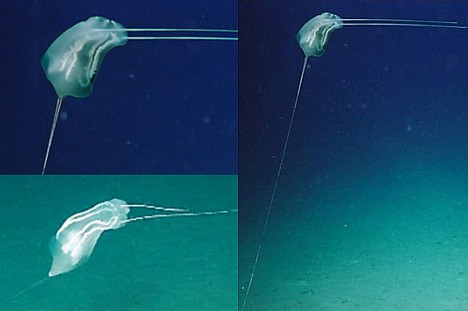
On June 11, the Japan Agency for Marine-Earth Science and Technology (JAMSTEC) released photographs of a mysterious deep-sea creature believed to be an unknown species of comb jelly, or ctenophore, a jellyfish-like marine animal. Taken by JAMSTEC's "Kaikou" unmanned submersible at a depth of 7,217 meters (nearly 24,000 feet) in the Ryukyu Trench about 200 kilometers (125 miles) south of Okinawa, the photographs show a gelatinous animal with two pairs of long, spindly tentacles -- one pair extended horizontally in front of its body and one pair stuck to the ocean floor, allowing the creature to float in place like a kite.
The creature's elongated body is 10 to 20 centimeters (4 to 8 inches) long and 5 to 8 centimeters (2 to 3 inches) wide. The rear tentacles measure 1.5 to 2.5 meters (5 to 8 feet) in length, while the forward-reaching tentacles, which float on the current and catch prey, measure between 1 and 1.5 meters (3 to 5 feet) in length. The animal's gastrovascular system, which circulates nutrients through the body, appears whitish in color.
JAMSTEC filmed the gelatinous animal in April 2002, and subsequent research has led the researchers to conclude it is very likely a new species. However, they are unable to say for certain until they capture an actual specimen.
[Source: Asahi, JAMSTEC press release, photos]
studying ichthyology
huh. it's probibly a regular jellyfish that got beat up a bit. it happens all the time. people get all excited about finding a "new species" when it is infact a very common species, just deformed or scar'd. i wouldnt put any money on that one.
[]adept in logic skills
What an ill informed comment... How could this be just some "beat up" regular jellyfish. They claimed this specimen was attached to the sea floor, a regular old jellyfish species would take hundreds of thousands to millions of years to develop a useful adaptation like attaching to the ocean floor. The horizontal tendrils must be used for navigation, or even sensing prey.
[]Nick
You are a moron. You obviously have yet to view for yourself what really lies in the deep ocean if you see this creature as "just a deformed organism". If you have, you would know the strange, yet extremely fascinating, marine life that inhabit the deep oceans of the world. Take the Marrus Orthocanna for example. How does its shape and design have anything to do with it keeping itself alive? Where are its eyes? Does it even have any? Did it always look like this? All these questions are a mystery as these creatures have adapted to live the life they do without us knowing how or why.
[]Umad
U mad bro?
[]Hobittual
You were doing OK, laying it on the line to this apparent low profiler, then with scant regard to the lofty perch you had just acquired, you laid waste to all possible kudos by using the other fellas disgrace as a platform from which to launch "The Nick Show"!
Marrus Orthocanna indeed! No other fucker knows the slightest thing about "Marrus Orthocanna". For all we know it is some kind of yeast infection.
The opinion of Mr "Studying Ichthyology", is beginning to appeal to me more and more.
[]STUDYiNG MARiNE BiOLOGY
this stuff is crazy and so fascinating. this is exactly why i love what i do. learning about all these new and exciting species that are discovered and examined each year blows my mind. aquatic nature is really and sadly more interesting than human life. go figure.
[]monkeyman
I LIKE MONKEYS
I like monkeys.
The pet store was selling them for five cents a piece. I thought that
odd since they were normally a couple thousand each. I decided not to
look a gift horse in the mouth. I bought 200. I like monkeys.
I took my 200 monkeys home. I have a big car. I let one drive. His
name was Sigmund. He was retarded. In fact, none of them were really
bright. They kept punching themselves in their genitals. I laughed.
Then they punched my genitals. I stopped laughing.
I herded them into my room. They didn't adapt very well to their new
environment. They would screech, hurl themselves off of the couch at
high speeds and slam into the wall. Although humorous at first, the
spectacle lost its novelty halfway into its third hour.
Two hours later I found out why all the monkeys were so inexpensive:
they all died. No apparent reason. They all just sorta' dropped dead.
Kinda' like when you buy a goldfish and it dies five hours later. Damn
cheap monkeys.
I didn't know what to do. There were 200 dead monkeys lying all over my
room, on the bed, in the dresser, hanging from my bookcase. It looked
like I had 200 throw rugs.
I tried to flush one down the toilet. It didn't work. It got stuck.
Then I had one dead, wet monkey and 199 dead, dry monkeys.
I tried pretending that they were just stuffed animals. That worked for
a while, that is until they began to decompose. It started to smell real
bad.
I had to pee but there was a dead monkey in the toilet and I didn't want
to call the plumber. I was embarrassed.
I tried to slow down the decomposition by freezing them. Unfortunately
there was only enough room for two monkeys at a time so I had to change
them every 30 seconds. I also had to eat all the food in the freezer so
it didn't all go bad.
I tried burning them. Little did I know my bed was flammable. I had to
extinguish the fire.
Then I had one dead, wet monkey in my toilet, two dead, frozen monkeys in
my freezer, and 197 dead, charred monkeys in a pile on my bed. The odor
wasn't improving.
I became agitated at my inability to dispose of my monkeys and to use the
bathroom. I severely beat one of my monkeys. I felt better.
I tried throwing them way but the garbage man said that the city wasn't
allowed to dispose of charred primates. I told him that I had a wet
one. He couldn't take that one either. I didn't bother asking about the
frozen ones.
I finally arrived at a solution. I gave them out as Christmas gifts. My
friends didn't know quite what to say. They pretended that they like
them but I could tell they were lying. Ingrates. So I punched them in
the genitals.
I like monkeys
[]E
I had to copy then save your comment because it was too funny
[]Name (required)
i had to see your comment then count how many years back it was i saw it first
[]AusMounty
It looks like the Blue Bottle jelly fish common in the waters on the east coast of Australia. And yes they are poisonous!
[]Sicarus
see what happens when you don't leave the undiscovered alone, Japan..
[]Luk
Did you REALLY just say that?
How incredibly ignorant are you?
[]Name (required)
Did you REALLY just question a troll on the internet about the content of their message?
How incredibly ignorant are you?
[]Umad
shhhh survival of the fittest... this is the internet... we have signs up... don't feed the trolls... but still if people don't pay attention... let the trolls have them...
[]dontbogartthat
LMFAO!! I lol'd for real on the monkey comment... then LOL'D at the japan comment... total douche bag comment yes... but if everyone could just lighten up a bit they'd see the humor too... ah well. crazy pic... crazier comments haha
[]carrie
beautiful. its really sad that we're destroying the earth so quickly and there are so many lifeforms we haven't even discovered yet. :(
[]bus driver
Carrie.....I hope you get hit with a bus!!
[]Umad
reply buttons are awesome
[]Crazed monkey
i dont like jelly fish..
but i do like monkeys..
The jelly news flash wasn't all that interesting to me.. no offense.. but the comments were hilarious.. upto the point where carrie gets hit buy a bus driven by a monkey.
[]cheers ppl.
nonan
i hope you get punched in the genitals
[]420
sausage mcmuffins
[]Umad
so... 2007 was the article... can we get an update? was it Nessie?
[]Michael Rice
The ocean never ceases to amaze.
[]